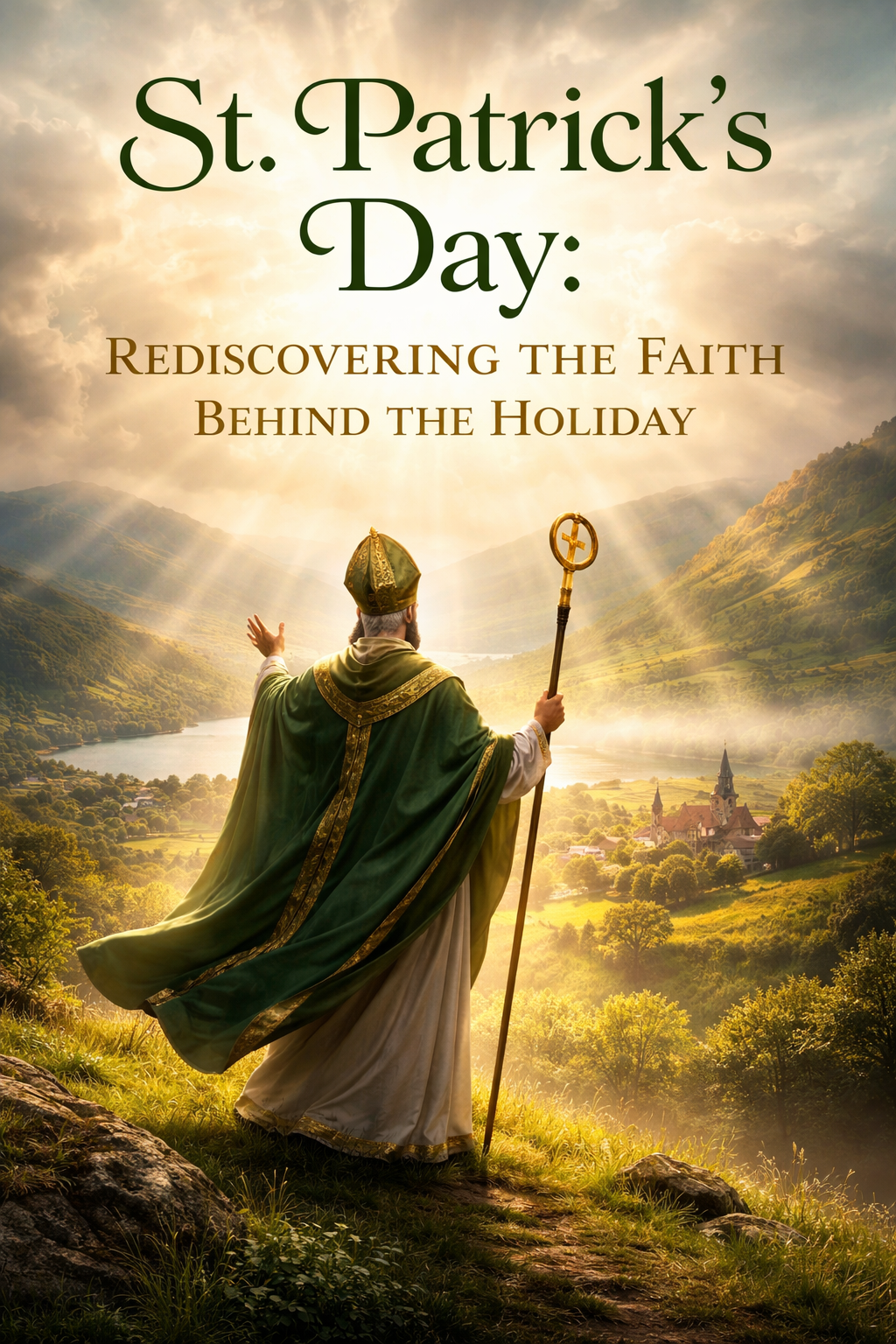
St. Patrick’s Day started as a religious commemoration of St. Patrick’s life and missionary work in Ireland. It originated as a religious feast day honoring him, the patron Saint of Ireland, celebrated on March 17th, the date of his death believed to be in 461 A.D.
Background

St. Patrick was not Irish by birth. He was born into a Christian family in Roman Britain around the 385 A.D. In his teenage years, he was grabbed by Irish raiders and taken to Ireland where he worked as a shepherd slave for several years. During those years, he strengthened his faith through prayer and eventually escaped back to his home country where he attended seminary, becoming a priest. After becoming a bishop, he felt a calling to return to Ireland and is credited with converting the heavily pagan island to Christianity.
Irish Catholics embraced him as one of their own and began celebrating St. Patrick’s feast day in the 9th or 10th century. It was not until the 17th century that the Catholic Church officially recognized St. Patrick’s Day as a feast day.
Traditionally, St. Patrick’s Day in Ireland was a more solemn religious occasion involving church services, feasts, and holy day observances — often with restrictions on work and celebrations during Lent (since March 17 frequently falls within that season).
As waves of Irish immigrants arrived (especially during the 19th century due to the Great Famine), the day grew into a major expression of Irish pride, identity, and community—featuring large parades, music, and cultural displays. Elements like dyeing rivers green (famously in Chicago since 1962), green beer, and corned beef and cabbage became prominent in America.
The modern, festive version of St. Patrick’s Day—with parades, wearing green, shamrocks, and public revelry—largely evolved outside Ireland, especially among Irish immigrants in the United States. Irish people began holding celebrations in America as early as the 1700s:

- The first recorded St. Patrick’s Day parade took place in Boston in 1737.
- New York City followed with one in 1762.
Ireland itself adopted many of these lively, secular traditions much later—influenced by the American celebrations—turning it into a bigger public festival by the mid-20th century (especially from the 1960s onward) to boost tourism and national pride.
St. Patrick’s Day eventually transformed into the global celebration of Irish culture we know today largely thanks to the Irish immigration to America.
What would St. Patrick think?
A holiday named after him has become much like Christmas and Easter and other spiritual holidays — occasions where the world has managed to transform a celebration of Christian faith into a largely secular and cultural event filled with green beer, matching attire, and shamrocks.
Yet if we pause for a moment and look past the parades and the green decorations, the real story of Patrick is far more meaningful than the celebration that surrounds his name.
Patrick’s life was not about luck. It was about redemption!
A young man who was kidnapped and enslaved found faith in God during his darkest years. When he finally escaped and returned home, he did not spend the rest of his life resenting the people who had wronged him. Instead, he felt called by God to return to Ireland — the very land of his captivity — to share the gospel of Jesus Christ with the people there.
That is the part of the story worth remembering, worth emulating, worth celebrating.

- Patrick returned not with anger, but with forgiveness.
- Not with revenge, but with the message of Christ.
- Not with cultural pride, but with the light of the gospel.
History tells us that his missionary work helped turn a pagan nation toward the worship of the one true God. That was Patrick’s mission, and that is the legacy behind the day that bears his name.
But like many things in our world, the meaning has slowly drifted.
- The celebrations grew.
- The decorations multiplied.
- The parades expanded.
And somewhere along the way, the spiritual heart of the day became quieter.
This is not unique to St. Patrick’s Day. The same thing has happened to many holidays that once pointed people toward God — even celebrations like Valentine’s Day, which has also drifted far from its spiritual roots. Human culture has a way of keeping the celebration while slowly forgetting the reason behind it.
“These people come near to me with their mouth and honor me with their lips, but their hearts are far from me.” — Isaiah 29:13
Yet the story of Patrick still whispers a simple truth.
God can transform a life. He has done it throughout history, and He continues to do it today in the lives of ordinary people who turn toward Him.
He can take a frightened young man enslaved in a foreign land and turn him into a messenger of hope. He can take bitterness and replace it with forgiveness. He can take darkness and fill it with light.
That same invitation still stands today.
So as March 17 arrives and the world dresses in green, perhaps the best way to honor Patrick is not merely by celebrating Irish culture, but by remembering the faith that defined his life.
Patrick did not go to Ireland to start a holiday.
He came to point people to Christ.
And that same Christ still calls to us today.

The world will always offer its celebrations, its noise, and its distractions — that often pull us away from the truth of God. But God continues to invite each of us into something deeper — a life filled with His presence, His grace, and His light.
So this St. Patrick’s Day, take a moment to look beyond the festivities.
Each of us eventually reaches a fork in the road where we must decide whether to follow the ways of the world or turn toward God. Choose God!
Seek His presence.
And allow His light to fill the places where this world can never satisfy.
The light shines in the darkness, and the darkness has not overcome it. – John 1:5
Because in the end, that is the legacy Patrick truly left behind.
As Patrick himself once prayed:
“Christ with me, Christ before me, Christ behind me,
Christ in me, Christ beneath me, Christ above me.”
Your comments are welcome – please review House Rules.
To protect your anonymity use a pseudo name.
Your email will not be seen, but a fake email is ok too.
Leave a Reply