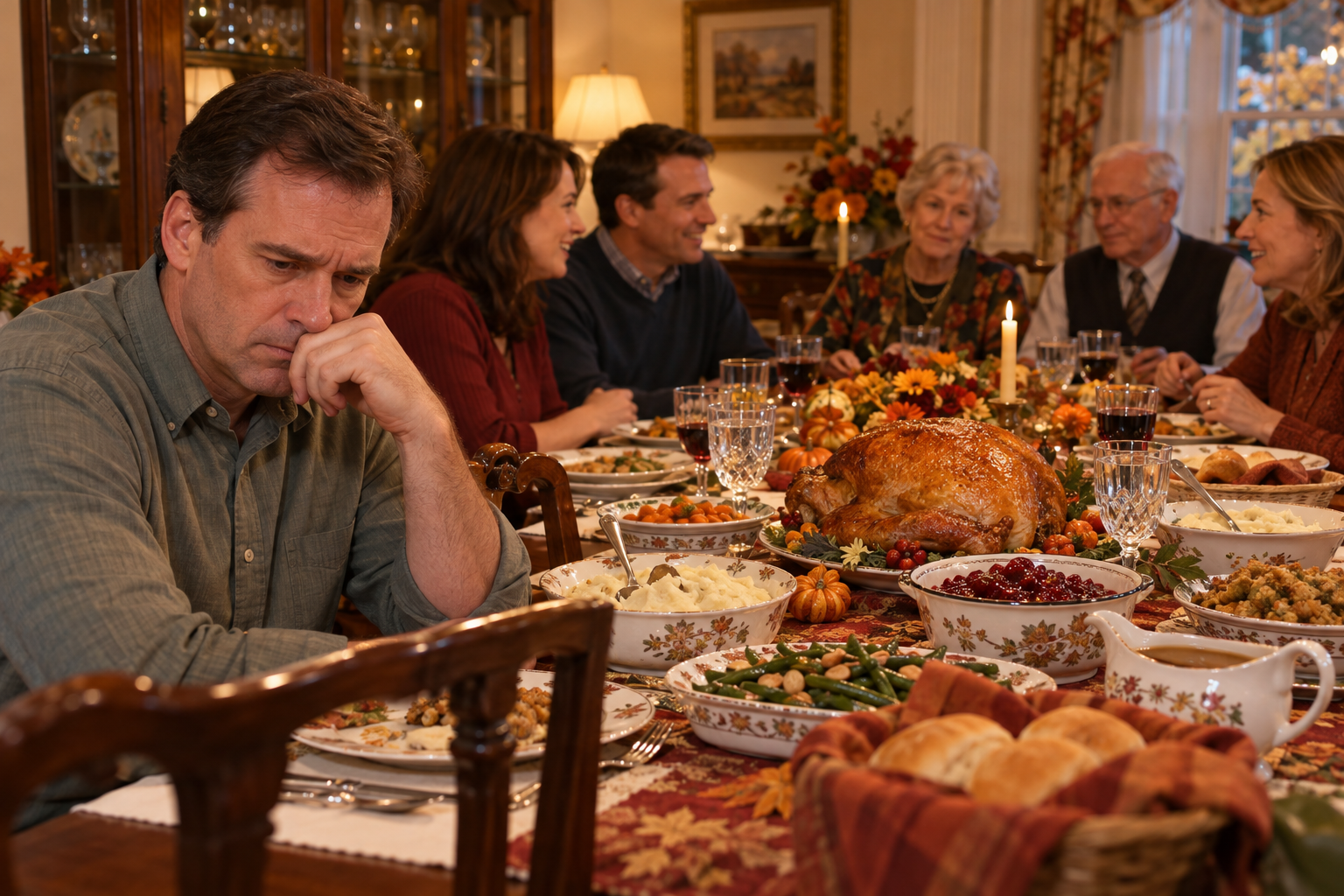
Years ago, when I lived in Maryland, we hosted a Thanksgiving gathering for about twenty-five people. When I learned that an older couple from our car club would be celebrating alone, I invited them to join us.
The adults sat in the formal dining room, while the younger adults and children gathered around the kitchen table, extended with a folding table. We said a familiar prayer of thanksgiving, and the feast began. The food was abundant and delicious.

Everything seemed to be going well until midway through the meal, when one couple began describing their recent trip to Europe. They spoke enthusiastically about the five-star hotels, ancient cities, and historic sites they had visited.
Another couple then shared their own adventures. They had trailered their horses to New England and enjoyed horseback riding, hiking, and biking in Acadia National Park.
As the couples described their travels, I noticed my older friends listening quietly. Something in their expressions made me uneasy.
When the second couple finished, the wife turned to our older guests and asked whether they had any adventures they would like to share.
“We don’t do exciting things,” the older woman replied. “We’re just poor folk from Glen Burnie.”
My heart sank. I had invited them so they would not spend Thanksgiving alone. Now I worried that the conversation had left them feeling out of place.
“We haven’t taken such elaborate trips either,” I began trying to save the situation.

But before I could elaborate, I felt my wife’s presence standing near me, she leaned over and whispered something in my ear.
Can this day get any worse? I thought.
My mother, who was in the early stages of Alzheimer’s, had been away from the table for some time. My wife had found her in the bathroom, confused and unwilling to come out because she could not find her underwear.
We did not know whether she had misplaced them, forgotten to put them on, or flushed them down the toilet. With a house full of guests and a septic system to consider, my imagination quickly supplied the worst possible outcome.
We searched, helped my mother through the situation, and eventually returned to the gathering. We never found the missing underwear and thankfully no plumbing disaster followed. But my peace was gone.

Soon, coffee and an assortment of desserts were served. I had difficulty enjoying the sweets. I worried that my friends regretted accepting our invitation. I was unsettled by my mother’s confusion and the changes her illness was bringing.
There was plenty of delicacies on the table, but very little gratitude in my heart.
Giving Thanks in All Circumstances
The Bible calls us to practice thanksgiving as part of our daily walk with God:
“Rejoice always, pray without ceasing, give thanks in all circumstances; for this is the will of God in Christ Jesus for you.”—1 Thessalonians 5:16–18, ESV
Honestly, on that particular Thanksgiving Day, I was not prepared to give thanks in all circumstances.
I could give thanks when the meal went smoothly, everyone felt comfortable, and nothing unexpected happened. But when the conversation became awkward and my mother needed help, my attention shifted entirely to what was going wrong.
Looking back, I can see how much my peace depended on circumstances remaining under my control.
A Reflection – Prayer Without Much Thought
That Thanksgiving took place before my spiritual awakening. I attended church, observed religious holidays, and participated in familiar traditions and ceremonies. But I did not yet have the personal relationship with Jesus Christ that I enjoy today.
We began the meal with words I had known since childhood:
“Bless us, O Lord, and these Thy gifts…”
There is nothing wrong with rote prayers. I am sure God hears them. The problem was that I spoke it with little gratitude in my heart which is the danger of reciting prayers you learned as a toddler. Jesus died on the cross for us, the veil was torn so that we can go directly to God the Father in verbal spontaneous prayer, and yet the best I could give Him was a memorized prayer I learned as a child. How sad is that?
God had provided the feast, the home, and the people gathered around our table. Yet I barely paused to acknowledge Him. I treated prayer largely as an obligation to finish before we could begin eating.
Years later, I began to understand what finding peace through thanksgiving meant as I brought my own worries to God.
Finding Peace Through Thanksgiving
For years, I understood thanksgiving mainly as a response to something good. God provided us blessings and we were thankful for them.
But the apostle Paul connects thanksgiving with the way we bring our worries to God:
“Do not be anxious about anything, but in everything by prayer and supplication with thanksgiving let your requests be made known to God. And the peace of God, which surpasses all understanding, will guard your hearts and your minds in Christ Jesus.”—Philippians 4:6–7, ESV
Notice where thanksgiving appears. It accompanies our requests, even while the concerns that brought us to prayer remain unresolved.
We can tell God what bothers us. We can ask Him for help. And in the same prayer, we can thank Him for His faithfulness, His mercy, and His presence.
Of course, now I start every day with a prayer of thanks. Being thankful helps remind me of the One to whom I should be praying. He has sustained me before. He knows what I cannot see. My circumstances have not escaped His care.
Giving thanks in hardship does not require me to pretend that hardship is pleasant. I do not have to call an illness, an injustice, or a painful loss good. But even there, I can thank God that I belong to Him and that He has not abandoned me.
The peace comes from Him as I entrust my concerns to His care.
What Would Have Been Different?
Now don’t get me wrong. If I had enjoyed the same personal relationship with God on that Thanksgiving Day that I enjoy today, I doubt that any of the events would have changed.
The couples might still have shared their travel stories. My older friends might still have felt uncomfortable. My mother might still have become confused.
But I would have managed those moments differently – with a peace that surpasses all understanding.
I would have asked God for wisdom to make my older guests feel included. I hope I would have helped my mother with greater patience while thanking Him that she was still with us. I would have acknowledged my own limitations instead of allowing the need to control everything to consume me.
I am not the same person now – God has truly transformed my heart. I rest in His peace because:
I know that God is sovereign,
Nothing happens without God’s permission,
I have submitted my will to His will,
and I trust Him with all of my heart, mind, and soul, my whole being – my entire essence.
That does not mean I never feel concern or sorrow. It means I know Who I can trust to handle every situation. And I can thank Him with full trust and confidence before I know the outcome.
Peace Through Greater Trials
That uncomfortable Thanksgiving pales in comparison with some of the experiences I have faced since coming to know Christ.
I have been aboard a sailboat in the Atlantic Ocean, about seven hundred miles from the nearest land, with a failed engine. We faced gale-force winds, twelve-foot seas, little food, and no drinking water. For three days, we drank Gatorade. I have not desired to drink a Gatorade since.

The circumstances were seriously significant, but I experienced peace.
My prayer was simple: “Your will be done.”
God brought my crew and me safely home, and I remain thankful for His care through that harrowing journey.
In another chapter of my life, I had been wrongly accused of something terrible in a very public way. Some of my loved ones believed the accusation, which made the hurt even deeper. I turned to God at the unfairness of the situation. His answer was brief and almost like a whisper – “Trust Me.” I was obedient and did not defend myself publicly or pursue legal action. I prayed for God to heal the mind and heart of my accuser and entrusted my own hurt to Him.
I lost a kidney after a surgeon accidentally clipped my right ureter during robotic surgery at Johns Hopkins Hospital in Baltimore. I chose not to sue and placed the matter in God’s hands.
In each situation, God helped me keep anger and the desire for vindication from taking over my life.
I have experienced financial setbacks that would once have undone me in the past. Through them, I learned to thank God for what remained and trust Him for what I needed.
And I have spent four years battling cancer.
Time in an oncology unit changes your perspective. When you see people half your age—and younger—facing serious illness, you begin to recognize how much you have already been given.

Not once did I ask God why. I thanked Him for the many years He had given me. I prayed for the younger patients, asking Him to give them healing, strength, and more years with the people who love them. And I thanked Him for my wonderful wife who patiently waited through the rounds of tests and scans, always greeting me with a smile afterward.
Throughout my stage III and IV treatments, I experienced a peace I could not have produced on my own. Today, rather than allowing the possibility of the disease returning again to consume my thoughts, I thank God for each day and the blessings it holds.
I do not know what tomorrow will bring. I know the One to whom I entrust it.
Returning to that Thanksgiving Table
When I reflect on that long-ago Thanksgiving, I now see more than an awkward conversation and a distressing interruption.
I see friends who accepted our invitation. I see my mother, still able to share a holiday meal with us. I see my wife caring for her. I see a home filled with people and a table covered with abundant nourishment.
The concerns were real. So were the blessings.
I was so focused on what I could not control that day rather than appreciate what God had already provided.
Today, I bring everything to Him including the concerns that weigh on my heart and the blessings for which I am grateful.
That is something we can practice this Thanksgiving, whatever our circumstances. We can speak honestly to our Father, ask for His help, and thank Him for His faithfulness.
We can trust Him with the things we cannot fix.
My Thanksgiving Prayer
May you enjoy a personal relationship with God the Father, God the Son, and God the Holy Spirit. May you always be turned toward Him, be filled with His light, and choose to live your life in agreement with His will – in your thoughts, your purpose, and your actions as guided by His Holy Spirit. May you appreciate what it means to be thankful. In Jesus’ name! – Amen
Happy Thanksgiving!
Your comments are welcome – please review House Rules.
To protect your anonymity use a pseudo name.
Your email will not be seen, but a fake email is ok too.
Leave a Reply