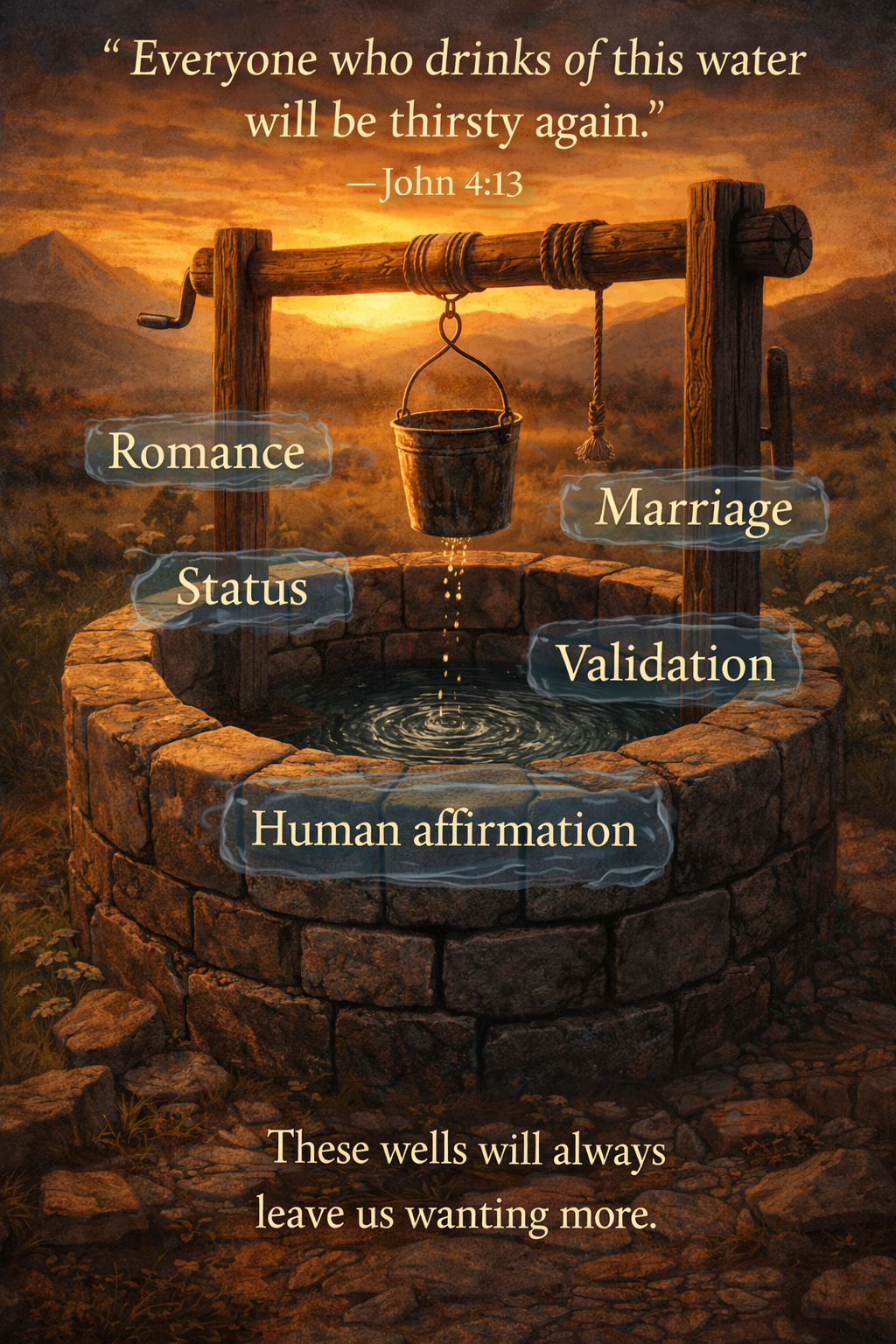
John 4:4–42 tells the story of Jesus encountering a Samaritan woman alone at Jacob’s well as she draws water. She is astonished when Jesus reveals intimate details about her life: she has had five husbands, and the man she is now living with is not her husband.

This passage reminds me of the classic country song “Lookin’ for Love (in All the Wrong Places)” by Johnny Lee. The lyrics describe someone desperately searching for love in fleeting, unfulfilling places—bars, casual encounters, and empty relationships—only to keep coming up empty. Like the singer, the Samaritan woman seems to have been chasing something to fill a deep void, trying relationship after relationship (at least five, and now a sixth) to satisfy an unrelenting ache.
What was that ache? Scripture doesn’t spell it out explicitly, but we can reasonably see her turning to men for things only God can provide:
- A sense of identity
- Relief from loneliness
- Validation of her self-worth
- A feeling of spiritual completion
The well is a powerful image. The woman goes there daily to draw water to fulfill a physical thirst that is never quenched. In comparison, she looks to draw on the relationships of multiple men over time. Neither has quenched her deepest thirst.
She was seeking love and fulfillment through human connections alone. But seeking ultimate satisfaction in any human relationship—romantic or otherwise—will always leave us thirsty. Human love, while beautiful and valuable, is not sustaining. It cannot bear the full weight of our hearts. People often move from one relationship to the next, convinced the next person will finally quiet the inner ache. Yet they misdiagnose the ache: it is not merely romantic or emotional—it is spiritual.

Some might read this story primarily as a lesson about marriage or sexual sin, but its deeper message is about:

It all begins with God. He is the source of true love—not something we earn through performance, but a gift we receive by grace.
Our response to God’s initiating love is trust. When we freely receive His love, we return it through trust—surrendering our will to His. Until we trust in God’s unfailing love, we cannot fully surrender to Him.
That trust leads to transformation, which bears fruit: genuine love for others.
We can’t truly love one another when we:
- Dominate or withdraw from each other
- Feel the need to compete with each other
- Defend our self-worth
- Place unrealistic expectations on each other
But when we are secure in God’s love and fully trust Him, obedience flows naturally. We come to know who we are because we know who He is. The fruit of that relationship is freedom: we no longer need to seek from people what God has already given us in abundance.
When Jesus tells the woman, “Everyone who drinks of this water will be thirsty again” (John 4:13), He is pointing out that drawing from the worldly wells of:

Human love can be a great blessing, but only divine love truly fulfills and sustains us. God’s love carries us through storms and suffering, grounds our identity, secures our worth, and provides an unshakable foundation.
Our Christian life is not built on performance, works, law-keeping, or religious achievement. It is built entirely on Christ’s love. We cannot fully grasp or reflect Christ’s love unless we are first rooted and established in it. Human relationships—between husband and wife, parent and child, siblings, friends—are precious gifts, but only divine love can quench the soul’s deepest thirst.
Jesus declared, “I am the way and the truth and the life. No one comes to the Father except through me” (John 14:6). And Scripture affirms, “And there is salvation in no one else, for there is no other name under heaven given among men by which we must be saved” (Acts 4:12).
Jesus is the One our hearts have been searching for all along. Turn to Him, drink deeply of His living water, be filled with His light, and choose to live in alignment with His will. Salvation comes only to those who take hold of Jesus as their Messiah—for the absolute truth is that salvation is found in no one else.
Your comments are welcome – please review House Rules.
To protect your anonymity use a pseudo name.
Your email will not be seen, but a fake email is ok too.
Leave a Reply