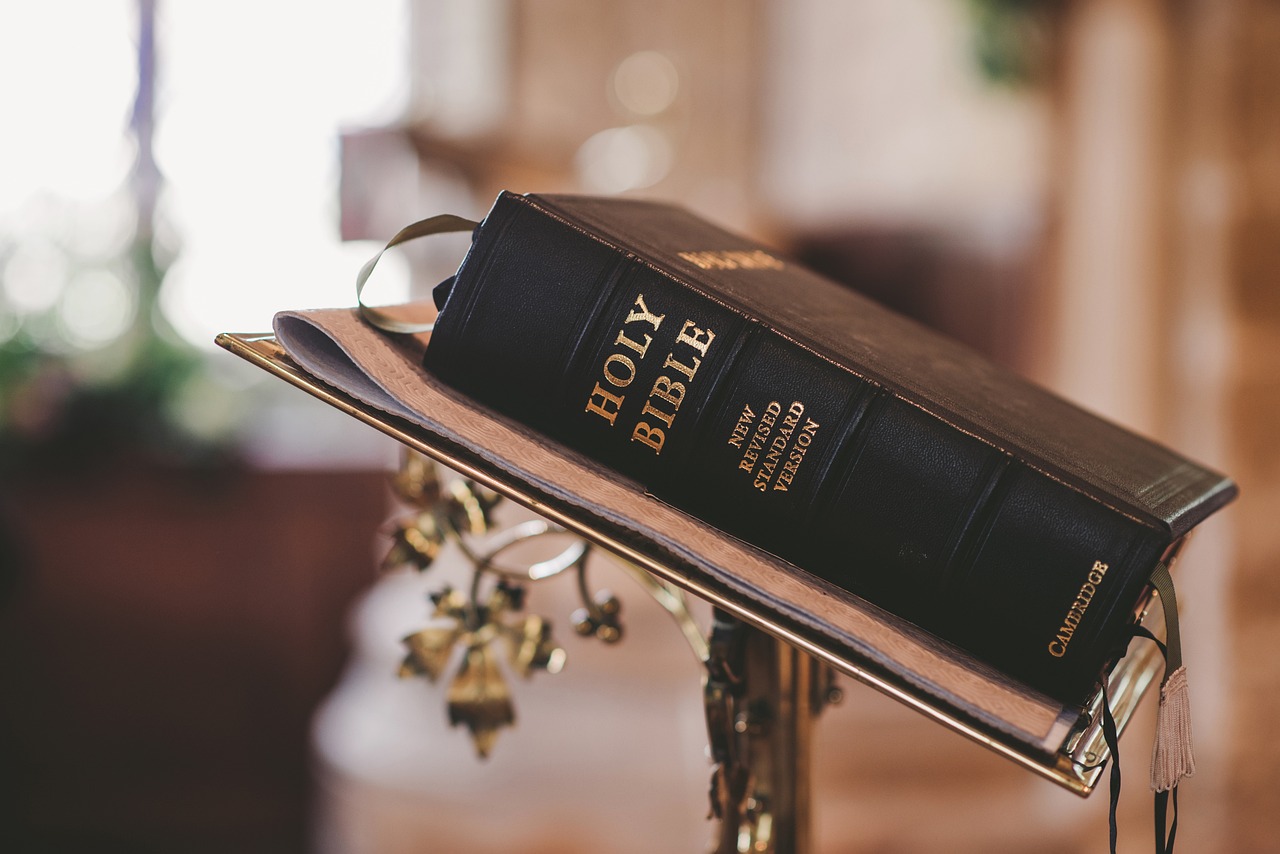
One of my pet peeves is hearing a pastor or fellow believer support an opinion by saying, “You don’t have to take my word for it—the Bible says so.”
That ought to settle the matter—but only when the Bible actually says so.
Sometimes I privately think (WTF), but I am not supposed to say stuff like that — so the mature Christian in me will say out loud “what Bible are they reading?“. 🤷

I listen, probably wearing one of my best You can’t be serious expressions, as sincere Christians twist a passage like a pretzel until it supports something they already believe.
Then the Holy Spirit reminds me to be kind.
Most of these people are not false teachers deliberately trying to deceive anyone. They are fellow believers—my brothers and sisters in Christ. We share our faith in God the Father, God the Son, and God the Holy Spirit. They are not maliciously misrepresenting Scripture. More often than not, they are simply mistaken.
And, truthfully, I have been mistaken about Scripture too (but very rarely). 😊
That is why none of us should accept a teaching merely because someone attaches the words “the Bible says so” to it. Nor should we allow our personal preferences, traditions, or denominational beliefs determine what Scripture means.
Instead, we must examine God’s Word in its proper context and allow it to correct us—even when it challenges something we have believed for years.
When Personal Convictions Become Biblical Commands
One common example concerns alcohol.
I have heard pastors and other believers say drinking alcohol is wrong because it can lead to sin. Excessive drinking certainly can lead to sin, just as excessive eating, spending, gambling, or countless other behaviors can. But the Bible does not prohibit every consumption of alcohol.

Scripture says:
“Go, eat your food with gladness, and drink your wine with a joyful heart,
for God has already approved what you do.”
—Ecclesiastes 9:7
Jesus performed His first public miracle at the wedding in Cana by turning water into wine. Paul even advised Timothy to “use a little wine” because of his stomach and frequent illnesses.
At the same time, Scripture repeatedly warns about the dangers of alcohol. Proverbs tells us that wine can deceive us, and Paul commands Christians not to become drunk:
“Do not get drunk on wine, which leads to debauchery. Instead, be filled with the Spirit.”
—Ephesians 5:18
Taken together, these passages do not teach that every drink is sinful. They teach self-control and warn us against drunkenness, addiction, and allowing anything other than the Holy Spirit to control us.
There may also be sound reasons for a Christian to abstain completely. Some people struggle with addiction. Others may choose not to drink because it could cause another person to stumble. Romans 14 reminds us that Christian freedom should always be exercised with love and concern for others.
The problem arises when we turn a personal conviction into a commandment from God.
Someone may sincerely believe that abstaining from alcohol is the wisest choice for their life. I respect that decision. But saying, “I believe Christians should not drink,” is different from saying, “The Bible says Christians cannot drink.”
We should never make Scripture say more—or less—than it actually says.
Why So Many Christians Disagree
Perhaps our tendency to mix personal opinions with God’s Word helps explain why Christians disagree about so many things.
Christians may worship differently, baptize differently, interpret prophecy differently, or disagree about how a church should be governed. Even within my own family, my siblings and I all believe Jesus Christ is our Lord and Savior, but we do not always agree about how we should worship Him.
If four siblings who grew up in the same house can disagree, I suppose I should not be surprised when millions of Christians around the world do the same.

Some disagreements involve essential Christian doctrines. Others concern secondary issues that do not determine whether someone is saved. We should never compromise the truth, but we should also be careful not to treat every disagreement as evidence that someone is not a genuine Christian.
We can disagree without becoming enemies.
We can correct one another without becoming cruel.
And sometimes we must possess enough humility to admit that the person who needs correction may be the one in the mirror.
When Someone Says, “The Bible Says So”

Many Christians rarely open the Bible outside of church. When that happens, they become dependent upon someone else to tell them what God’s Word says.
That can be dangerous.
Pastors and Bible teachers serve an important role, and I am grateful for the faithful people who have helped me understand Scripture. But no pastor, priest, teacher, author, commentator—or blogger—is incapable of making a mistake.
That includes me.
The people of Berea provide us with a wonderful example. After Paul and Silas arrived and began preaching, the Bereans did something remarkable:
“Now the Berean Jews were of more noble character than those in Thessalonica, for they received the message with great eagerness and examined the Scriptures every day to see if what Paul said was true.”
—Acts 17:11
Think about that for a moment.
The apostle Paul was teaching them, yet they still examined the Scriptures to determine whether his message was true. Paul was not offended by their questions. Luke described the Bereans as being of “noble character” because they eagerly listened and then verified what they had heard.
They possessed both an open mind and an open Bible.
We should do the same.
When a pastor says, “The Bible says so,” look up the passage. Read the verses before it and after it. Determine who is speaking, who is being addressed, and what circumstances prompted the words. Compare the teaching with the rest of Scripture.
One isolated verse can appear to support almost anything when it is removed from its context.
My Mother’s Blessed Bible
I did not always begin my mornings studying Scripture. In fact, if someone had told me twenty years ago that Bible study would become part of my daily routine, I probably would have laughed.
Other than hearing God’s Word in church, my family did not regularly read the Bible together.

My parents received a beautiful Bible as a wedding gift. Bound in genuine leather with gilded edging and a gold ribbon marker, it held a venerated position in our living room, where my siblings and I were forbidden to play or sit on the furniture.
I was about ten years old when my mother caught me exploring that Bible with my dirty little fingers.
“Don’t touch that,” she exclaimed. “It’s blessed!”
Mom meant well. She revered the Bible so much that she wanted to protect it. But a Bible is not meant to remain untouched on a shelf. Its pages are meant to become worn. Its passages are meant to be studied, questioned, understood, and lived.
A pristine Bible may look beautiful in a living room, but an open Bible can transform a life.
Learning to Feed My Mind

I once heard an illustration about two wolves—one good and one bad—competing for influence within us. According to the illustration, the wolf that eventually wins is the one we feed.
Reading God’s Word every morning feeds the good wolf in me.
That story does not come from the Bible, but it illustrates a biblical truth: what we continually feed our minds will influence the direction of our lives.
Paul wrote:
“Do not conform to the pattern of this world, but be transformed
by the renewing of your mind.”
—Romans 12:2
Studying God’s Word every morning renews my mind. It helps me recognize the difference between God’s truth and human opinion—including my own.
The more time I spend with Scripture, the easier it becomes to recognize when a verse is being misused. In the same way that a bank teller learns to recognize counterfeit money by becoming familiar with genuine currency, Christians learn to recognize distorted teaching by becoming increasingly familiar with the truth.
We cannot recognize a counterfeit if we have never studied the genuine article.
Ask the Holy Spirit for Help
Understanding Scripture requires more than intelligence or education. We need the guidance of the Holy Spirit who can open our spiritual eyes and help us recognize truths we previously failed to see.
Jesus called Him “the Spirit of truth” and promised that He would guide His followers into truth. Before reading Scripture, ask the Holy Spirit to give you wisdom, humility, and understanding.
Sometimes a passage may become clear immediately. At other times, the Spirit may lead you to another passage, a trusted teacher, or a thoughtful commentary that helps explain the historical and biblical context.
However, we should be cautious about claiming, “The Holy Spirit told me this verse means…” when our interpretation contradicts the passage itself or the broader teaching of Scripture. The Holy Spirit inspired the Word of God. He will not guide us into an interpretation that conflicts with what He has already revealed.
The Spirit helps us understand Scripture; He does not give us permission to rewrite it.
Test What You Hear
The next time someone says, “The Bible says so,” consider asking a few questions:
- Where does the Bible say that?
- What do the surrounding verses say?
- Who was the author addressing?
- Is this a direct command, a historical description, a proverb, or a parable?
- Does this interpretation agree with the rest of Scripture?
- Am I allowing the Bible to shape my beliefs, or am I trying to make the Bible confirm what I already believe?
Those questions are not evidence of weak faith. They demonstrate a sincere desire to know the truth. Honest questions are not necessarily evidence of unbelief; there is an important difference between fear, doubt, and rejecting God.
God is not threatened by honest questions.
Don’t Take My Word for It
God created everything, including every one of us. He made human beings in His image and loves us so deeply that He sent His Son, Jesus Christ, to save us from sin and eternal death. He has given us His written Word and the Holy Spirit to teach us how to live in this physical world while preparing us for His eternal Kingdom.
If you are new to Enjoying His Presence and your are not entirely on board with this whole God thing; this is where I petition you to give God a chance. Turn towards Him, be filled with His light and choose to live your life in agreement with His will. It’s why we were all created and deep down, we all know it to be true.
But don’t simply take my word for it. 😊

Your comments are welcome – please review House Rules.
To protect your anonymity use a pseudo name.
Your email will not be seen, but a fake email is ok too.
Leave a Reply