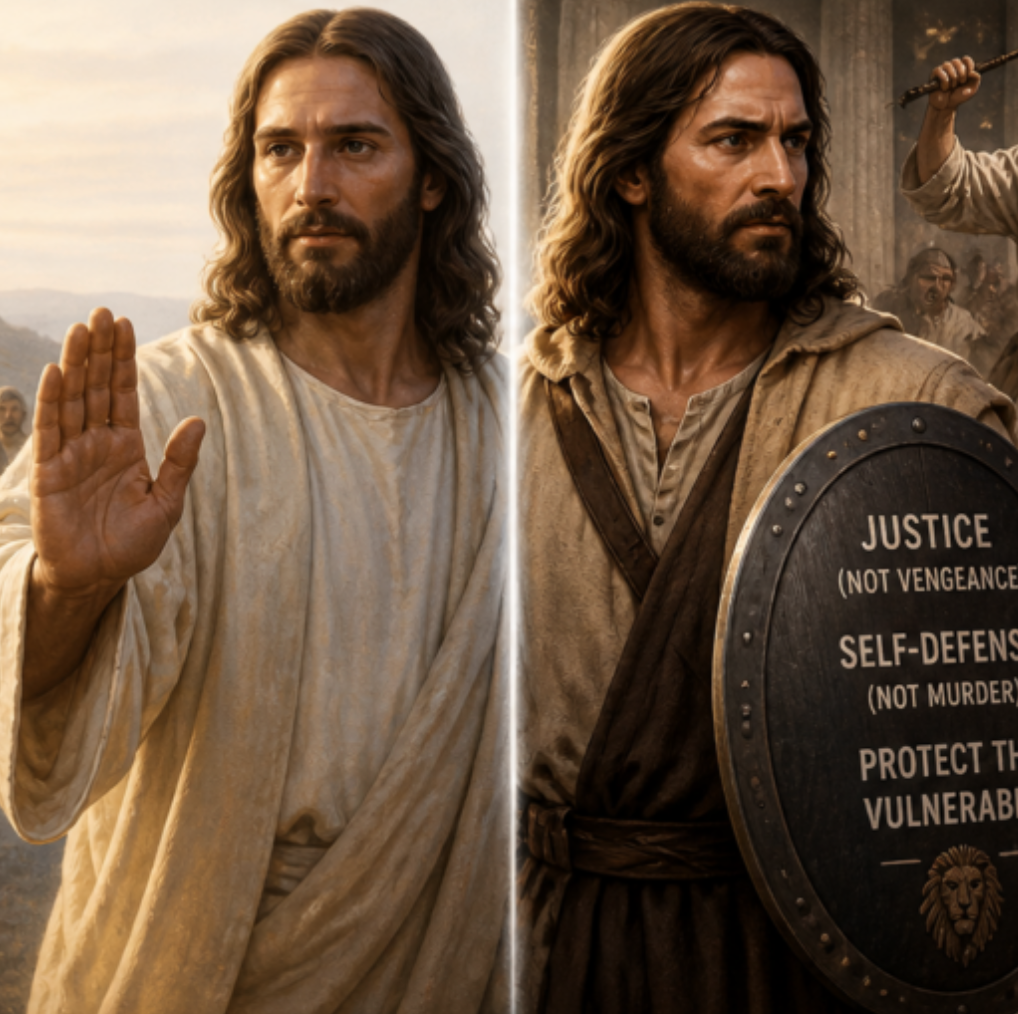
We’ve all heard the claim: Jesus was a gentle, turn-the-other-cheek pacifist who would never approve of violence or self-defense.
Modern culture loves this version of Jesus—soft, non-confrontational, and safe.
But is that the Jesus we actually encounter in Scripture?
Or do we find Someone who understands the harsh realities of a fallen world far better than we often assume?

Jesus was fully God and fully man. He taught radical love and personal non-retaliation—but He also affirmed justice, self-defense, righteous anger, and practical wisdom for a dangerous world.
Let’s take a closer look at what the Bible actually says.
Weapons at the Last Supper and
in the Garden of Gethsemane
Right before His arrest, Jesus gave His disciples some very practical instructions:
“But now let the one who has a moneybag take it, and likewise a knapsack. And let the one who has no sword sell his cloak and buy one.” – Luke 22:36
The disciples already had swords—at least two (Luke 22:38). Jesus didn’t rebuke them. Instead, He told them to be prepared.
Some argue this was only to fulfill prophecy—that He would be “numbered with the transgressors.” But that does not account for the fact that they already had two swords and Jesus was saying for those without a sword to buy one. These men lived in a tough world, and it was about to get tougher. Jesus knew it.
A short time later, in the Garden of Gethsemane, Peter drew his sword and cut off the ear of the high priest’s servant (John 18:10).
Jesus immediately told him to put it away:
“Shall I not drink the cup the Father has given me?” (John 18:11)
Matthew adds:
“All who draw the sword will die by the sword” (Matthew 26:52)
Jesus wasn’t condemning the possession of swords—He was stopping Peter from interfering with God’s redemptive plan. That moment required:
- submission to the cross,
- surrender,
- not resistance.
This is a good example of where context matters when reading Scripture.

“Turn the Other Cheek” = Insult, Not Murder
One of the most misunderstood teachings is Matthew 5:39:
“But I say to you, Do not resist the one who is evil. But if anyone slaps you on the right cheek, turn to him the other also.”
Was Jesus telling us to stand by while someone beats us to death?
Absolutely Not!
In that cultural context, a backhanded slap to the right cheek was an insult—a deliberate act of humiliation from someone in a position of authority.
Jesus was teaching His followers not to escalate personal insults or seek revenge over wounded pride.

This teaching is about personal relationships and enemy love (praying for someone when they slander you)—not a blanket prohibition against self-defense or justice.
Jesus never taught that evil should be allowed to run unchecked.
What the Bible Says About Self-Defense
The Old Testament law—affirmed and fulfilled by Jesus—gives clear guidance:
“If a thief is found breaking in and is struck so that he dies, there shall be no bloodguilt for him, but if the sun has risen on him, there shall be bloodguilt for him. He shall surely pay…” – Exodus 22:2-3 ESV
At night, in the dark, when you can’t easily assess the threat or call for help, deadly force in defense of your home and family brings no guilt. In daylight, when you can see the situation more clearly, you’re held to a higher standard. The principle is clear: protect the innocent, but don’t become a vigilante or murderer.
That same principle shows up in modern law.
For example, Florida’s “Stand Your Ground” law recognizes the right to meet force with reasonable force—including deadly force—when facing an imminent threat.
A real case illustrates the distinction.
A few years ago, a man in Florida defended himself against an attacker swinging a pipe.

He shot the aggressor in the chest and he went down. Then, instead of stopping, he stood over the incapacitated man and shot him again in the head. The jury didn’t convict him for the first shot in self-defense—they convicted him for the second, which crossed into vengeance.
That distinction feels very much in line with the heart of Scripture: protect life, but don’t cross into murder.
“Thou Shalt Not Kill” = “Thou Shalt Not Murder”
The Fifth Commandment uses the Hebrew word ratsach, which means unlawful, premeditated, or malicious killing—murder. It is not a blanket ban on all killing.
The same law that forbids murder also permits:
- Self-defense
- Capital punishment
- War in specific circumstances
Jesus deepened this command by addressing the heart:
Anger and hatred put us in danger of judgment – Matthew 5:21–22
But He never erased the distinction between murder and justified force.
Jesus and the Money Changers — Righteous Zeal, Not Passive Weakness
Nothing shatters the “meek and mild pacifist” image like the temple cleansing:
Jesus entered the temple and drove out all who sold and bought… He overturned the tables of the money-changers… “Take these things away; do not make my Father’s house a house of trade.” – John 2:13-17
He made a whip of cords and drove out the animals and exploiters. This wasn’t a polite conversation or a call for dialogue. It was decisive, forceful action against blatant evil and corruption happening in His Father’s house.
A true pacifist doesn’t act this way.
But someone who hates injustice—and loves righteousness—does.
My Conclusion: Jesus Was a Realist
Jesus is fully God and fully man.
As God, He could have called down legions of angels at any moment.
As man, He:
- Felt righteous anger
- Confronted evil
- Protected what was sacred
- Prepared His followers for a hostile world
He taught us to love our enemies and not repay personal insult with personal vengeance. But He never taught us to stand by passively while evil destroys the innocent, exploits the weak, or invades the home.
Jesus was not a pacifist in the modern, absolute sense.
He was a realist—full of grace and truth, wisdom and courage.
And He calls us to live the same way:
- Wisdom to know when to turn the other cheek
- Courage to stand when it truly matters
What do you think?
Does this change how you read these passages? I’d love to hear your thoughts in the comments.
Your comments are welcome – please review House Rules.
To protect your anonymity use a pseudo name.
Your email will not be seen, but a fake email is ok too.
Leave a Reply